
Springer
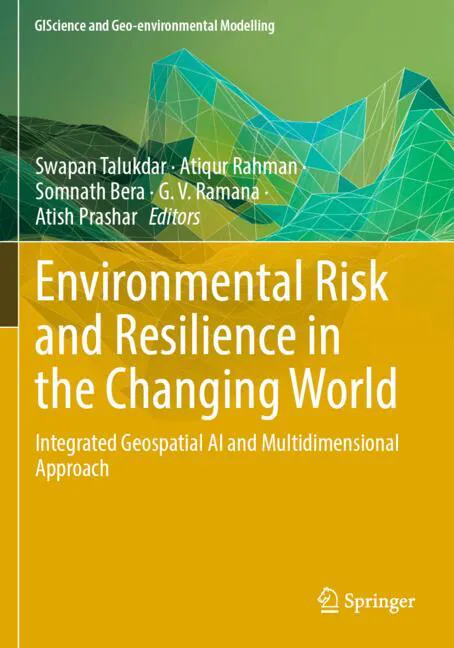
Environmental Risk and Resilience in the Changing World
Alin havaittu hinta
Hinnat kaupoissa
1 tarjousHinnat ovat viimeksi havaittuja. Tarkista ajantasainen hinta, saatavuus ja toimituskulut kaupasta.
Hintahistoria
1 hintahavaintoKaavio näyttää kunkin havaintopäivän alimman tallennetun tuotehinnan. Havaintojen välistä hintaa ei ole vahvistettu.
Hinta nyt 197,99 €. Alin havaittu 197,99 €, korkein 197,99 €.
- Alin havaittu
- 197,99 €
- Korkein havaittu
- 197,99 €
- Viimeisin historian havainto
Näytä hintahavainto
| Hinta havaittu (Suomen aika) | Hinta |
|---|---|
| 197,99 € |
Tuotetiedot
This book provides huge knowledge and data in the fields of geospatial sciences, earth environmental sciences, humanities, and social sciences, which target a diverse range of readers, such as academics, scientists, students, environmentalists, meteorologists, urban planners, remote sensing, and GIS experts. Earth environment (ecological envelope of geosphere, biosphere, hydrosphere, atmosphere and cryosphere) faces a significant challenge from different risks and threats due to due to rapid changes in global land use, population increase and pollution. They might drastically impair the ecosystem's ability to maintain long-term service levels while bolstering the economic, social, and environmental pillars of sustainable development. Therefore, risk assessment (RA) has lately become a prominent research topic and a powerful mechanism for enforcing legal activities-related environmental restoration and health improvements to do sustainable development. The United States Environmental Protection Agency (USEPA) first used the risk assessment approach in 1980, and since then, it has expanded and become standard practice in many areas of ecological research. Some practices are air quality assessment, land degradation assessment, natural hazards risk assessment, urban surface ecological health condition, wetland and forest health assessment and drinking water quality assessment. However, recently risk assessment alone is not sufficient to propose any sustainable management plans. Also, there is no universal strategy for conducting risk assessments, and insufficient expertise with the methodology may result in erroneous findings. Therefore, scientists are increasingly interested in developing resilience strategies with AI and geospatial-based risk assessment to lower environmental risk. Different resilience approaches make different assumptions about the system dynamics involved in resilience-based environmental risk and impact assessment. Therefore, this book seeks to showcase the most current advances in risk and hazards assessment of environments with resilience strategies to mitigate the prevailing environmental issues with the help of remote sensing, GIS, artificial intelligence, and state-of-the-art frameworks like PSR, VIOR, nature-based solutions.
- Brändi
- Springer
- EAN / GTIN
- 9783031624445