
Springer
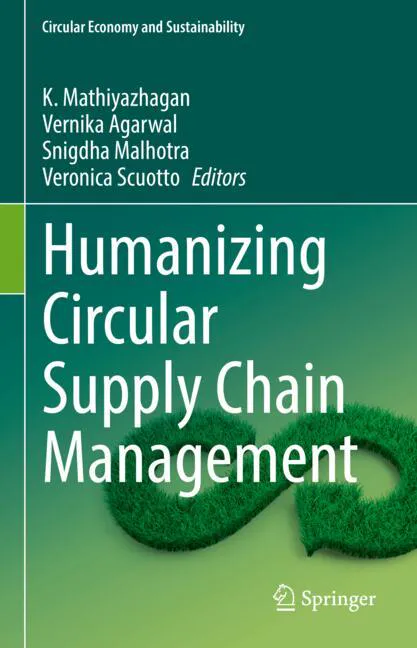
Humanizing Circular Supply Chain Management
Lowest observed price
Prices at stores
1 offerPrices are the most recently observed prices. Check the current price, availability and delivery costs at the store.
Price history
1 price observationThe chart shows the lowest recorded product price on each observation day. Prices between observations have not been verified.
- Lowest observed
- €175.99
- Highest observed
- €175.99
- Latest history observation
Show price observation
| Price observed (Finnish time) | Price |
|---|---|
| €175.99 |
Product details
This book the improvements in the circular economy are discussed, and a multidisciplinary approach is taken to examine developments in the recovery of value in CSCM. This book's main goal is to give readers a platform on which to discuss the role of human resources in effective supply chain management in a circular economy and how it may be used. CSCM is a new way of conducting business that offers a waste-free and sustainable substitute to the economy. The concept of CSCM is often incomplete if the human capital aspect of it is not covered. Human resources" or "human capital" represents a person's skills, talents, qualifications, and experiences. Thus, it is inconceivable that the shift to a circular economy would be successful without a new strategy for managing human resources. The COVID-19 epidemic has heightened and realigned the value of human capital inside organizations, whether it is through remote work policies, greater attention to employee health benefits, staff morale, or well-being concerns. It has provided HR professionals with the ability to reevaluate their interactions with employees and has made room for innovative working methods. To end the loop of the linear economic model, sustainability and sustainable improvements are prioritized internationally in all facets of organizations. The book offers the latest deveopments of Circular Supply Chain Management and its applications. It describes the role of human resources in regulating supply chains in the circular economy. The "take-make-waste" economic model in CSCM is encouraging us to rebuild better HR and entrepreneurial policies, which will be vital in building a stronger and more resilient company culture that maintains the value of all resources and is required to get through these trying times. To achieve this goal currently there exists a gap between the present skill sets and the skills required in future to generate new innovation and/or set a new business. In turn, this would request Continuous investment in employees’ development and training. Alongside, it involves a great attention on how humans are generating new innovations throughout the whole supply chain. At the moment, there is a focus on technologies and less consideration on humans in the field of supply chain management. Again, sustainability seems to be the new core of a company and its circulatory calls for a variety of human skills. In this scenario , the book's ultimate proposal is to give a research viewpoint that included views from policymakers, regulators, and practitioners. The book aims to address the significance of humanizing CSCM and also invites case studies on the topic. This book will meet the demands of research researchers, graduate students, and undergraduate students. Also, it will serve as reference information for academics, researchers, and industry professionals.
- Brand
- Springer
- EAN / GTIN
- 9783031865619