
Palgrave Macmillan
Money and Thoughtlessness
Lowest observed price
Prices at stores
1 offerPrices are the most recently observed prices. Check the current price, availability and delivery costs at the store.
Price history
1 price observationThe chart shows the lowest recorded product price on each observation day. Prices between observations have not been verified.
- Lowest observed
- €131.99
- Highest observed
- €131.99
- Latest history observation
Show price observation
| Price observed (Finnish time) | Price |
|---|---|
| €131.99 |
Product details
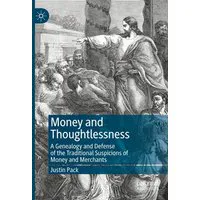
In this book, Justin Pack proposes a genealogy of the traditional suspicion of money and merchants. This genealogy is framed both by how money itself has changed and how different traditions responded to money. Money and merchants became heavily debated concerns in the Axial Age, which coincided with the spread of coinage. A deep suspicion of money and merchants was particularly notable in the Greek, Confucian and Christian traditions, and continued into the Middle Ages. These traditions wrestled with a new dialectic of purity that also appears with the widespread use of money. How were these concerns dealt with politically, socially and philosophically? How did they change over time? How did medieval Europe deal with money and how did this inform modern governmentality? To answer these questions, Pack turns to Hanna Arendt’s work. Arendt argues that one of the outstanding characteristics of our time is thoughtlessness. This thoughtlessness is related to how modern life, especially under neoliberalism, is increasingly structured by abstract systems, abstract calculative rationality, abstract relations, and the profit motive. Money both drives and embodies this machinery. The hyper-complex abstract systems of modernity discourage, to use Arendtian terms, “thinking” (wonder, questioning everything) in favor of “cognition” (problem solving). Too often the result is thoughtless cognition—the ability to make things more productive and efficient paired with the incapacity to question and challenge the implications and morality of these systems.
- Brand
- Palgrave Macmillan
- EAN / GTIN
- 9783031222634