
Springer
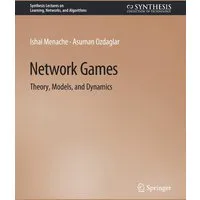
Network Games
Lowest observed price
Prices at stores
1 offerPrices are the most recently observed prices. Check the current price, availability and delivery costs at the store.
Price history
1 price observationThe chart shows the lowest recorded product price on each observation day. Prices between observations have not been verified.
- Lowest observed
- €38.49
- Highest observed
- €38.49
- Latest history observation
Show price observation
| Price observed (Finnish time) | Price |
|---|---|
| €38.49 |
Product details
Traditional network optimization focuses on a single control objective in a network populated by obedient users and limited dispersion of information. However, most of today's networks are large-scale with lack of access to centralized information, consist of users with diverse requirements, and are subject to dynamic changes. These factors naturally motivate a new distributed control paradigm, where the network infrastructure is kept simple and the network control functions are delegated to individual agents which make their decisions independently ("selfishly"). The interaction of multiple independent decision-makers necessitates the use of game theory, including economic notions related to markets and incentives. This monograph studies game theoretic models of resource allocation among selfish agents in networks. The first part of the monograph introduces fundamental game theoretic topics. Emphasis is given to the analysis of dynamics in game theoretic situations, which is crucial for design and control of networked systems. The second part of the monograph applies the game theoretic tools for the analysis of resource allocation in communication networks. We set up a general model of routing in wireline networks, emphasizing the congestion problems caused by delay and packet loss. In particular, we develop a systematic approach to characterizing the inefficiencies of network equilibria, and highlight the effect of autonomous service providers on network performance. We then turn to examining distributed power control in wireless networks. We show that the resulting Nash equilibria can be efficient if the degree of freedom given to end-users is properly designed. Table of Contents: Static Games and Solution Concepts / Game Theory Dynamics / Wireline Network Games / Wireless Network Games / Future Perspectives
- Brand
- Springer
- EAN / GTIN
- 9783031792472