
Springer
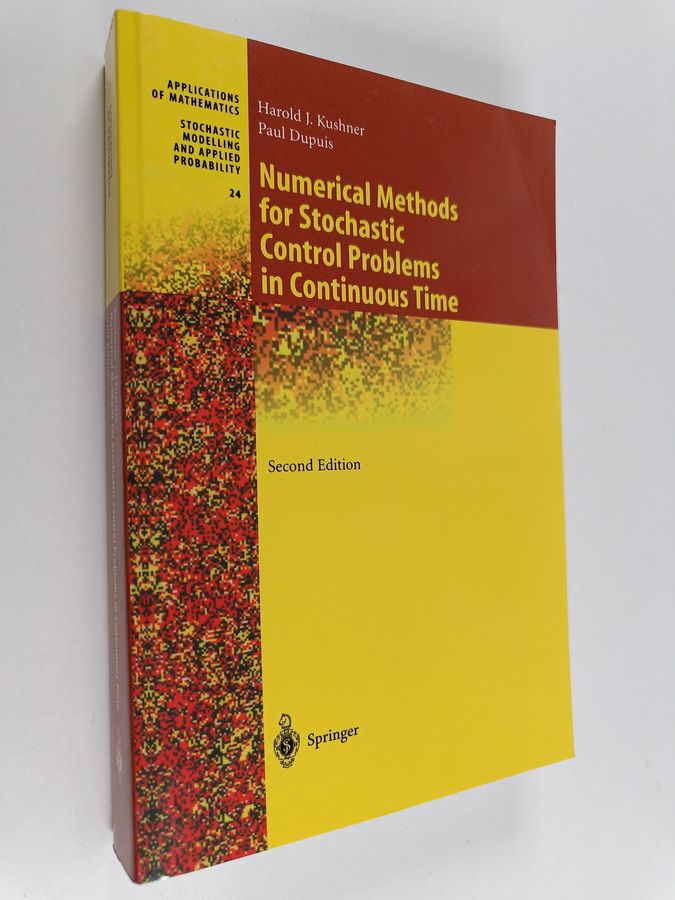
Numerical Methods for Stochastic Control Problems in Continuous Time
Lowest observed price
Prices at stores
1 offerPrices are the most recently observed prices. Check the current price, availability and delivery costs at the store.
Price history
5 price observationsThe chart shows the lowest recorded product price on each observation day. Prices between observations have not been verified.
- Lowest observed
- €100.00
- Highest observed
- €109.99
- Latest history observation
Show all 5 price observations
| Price observed (Finnish time) | Price |
|---|---|
| €109.99 | |
| €100.00 | |
| €109.99 | |
| €100.00 | |
| €100.00 |
Product details
Changes in the second edition. The second edition differs from the first in that there is a full development of problems where the variance of the diffusion term and the jump distribution can be controlled. Also, a great deal of new material concerning deterministic problems has been added, including very efficient algorithms for a class of problems of wide current interest. This book is concerned with numerical methods for stochastic control and optimal stochastic control problems. The random process models of the controlled or uncontrolled stochastic systems are either diffusions or jump diffusions. Stochastic control is a very active area of research and new problem formulations and sometimes surprising applications appear regu larly. We have chosen forms of the models which cover the great bulk of the formulations of the continuous time stochastic control problems which have appeared to date. The standard formats are covered, but much emphasis is given to the newer and less well known formulations. The controlled process might be either stopped or absorbed on leaving a constraint set or upon first hitting a target set, or it might be reflected or "projected" from the boundary of a constraining set. In some of the more recent applications of the reflecting boundary problem, for example the so-called heavy traffic approximation problems, the directions of reflection are actually discontin uous. In general, the control might be representable as a bounded function or it might be of the so-called impulsive or singular control types.
- Brand
- Springer
- EAN / GTIN
- 9781461265313