
Palgrave Macmillan
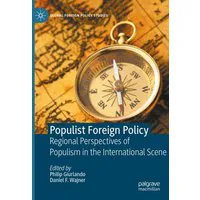
Populist Foreign Policy
Lowest observed price
Prices at stores
1 offerPrices are the most recently observed prices. Check the current price, availability and delivery costs at the store.
Price history
1 price observationThe chart shows the lowest recorded product price on each observation day. Prices between observations have not been verified.
- Lowest observed
- €153.99
- Highest observed
- €153.99
- Latest history observation
Show price observation
| Price observed (Finnish time) | Price |
|---|---|
| €153.99 |
Product details
This book explores the global phenomenon of populism in relation to states' foreign policy, addressing two key questions: How do populists mold their foreign policies? What are the domestic and external factors that enable and constrain it? To this end, the book brings together a diverse group of scholars who have already researched on populist foreign policies (PFP) in specific countries to contribute shared chapters that examine their drivers, patterns, and effects according to distinctive regions: North America, Western Europe, Southern Europe, Central-Eastern Europe, Latin America, South-East Asia, the Middle East, Oceania, and Africa. The empirical analysis sheds new light on how populists’ distinctive conception of a world divided antagonistically between “the people” and “the elites” influences behaviour towards multilateral organizations such as the United Nations and the European Union, and regional or global hegemonic powers like the United States, Germany, Russia, and China. The book also shows how ideas related to identity, ideology, status and emotions, impinge on populists’ conduct vis-à-vis other international actors, and how national and international structures affect the implementation of populist foreign policies in the regional, interregional, and global arenas. The wide geographical diversity and regional representation are also valuable in identifying cultural similarities and differences. Hence, the findings contribute to lively debates on whether there is a unified and coherent foreign policy among populist leaderships, and whether populism leads to a gradual “corrective” of transnational trends in contemporary politics or, conversely, to a more radical, structural shift in the liberal international order.
- Brand
- Palgrave Macmillan
- EAN / GTIN
- 9783031227721