
Springer
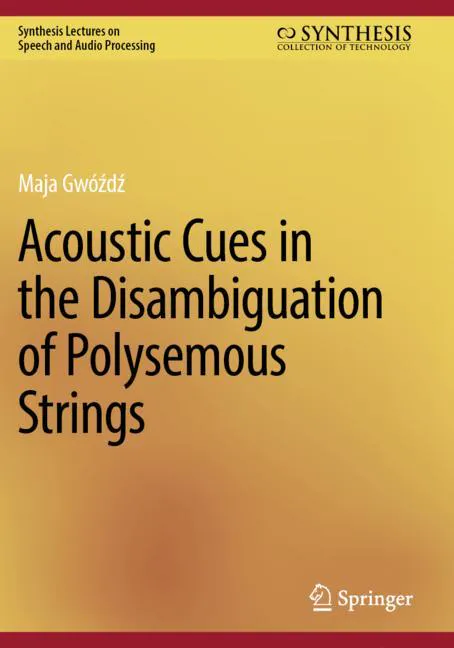
Acoustic Cues in the Disambiguation of Polysemous Strings
Lowest observed price
Compare prices: 1 store
1 offersPrices are the most recently observed prices. Check the current price, availability and delivery costs at the store.
Price history
1 price observationThe chart shows the lowest recorded product price on each observation day. Prices between observations have not been verified.
Current price €54.99. Observed 30-day low €54.99. Observed 90-day low €54.99. Current price is 0 % equal to 90-day average of observed daily lows.
- Lowest observed
- €54.99
- Highest observed
- €54.99
- Latest history observation
Show price observation
| Price observed (Finnish time) | Price |
|---|---|
| €54.99 |
Product details
This book provides an analysis of acoustic features of polysemous strings and an implementation of a speech disambiguation program based on the phonetic information. Throughout the book, the term ‘polysemous string’ refers to idioms with plausible literal interpretations, restrictive and non–restrictive relative clauses, and the same expressions used as quotations and appearing in a non–quotational context. The author explains how, typically, context is sufficient to determine the intended meaning. But there is enough evidence in psycholinguistic and phonetic literature to suspect that these superficially identical strings exhibit different acoustic features. In the experiment presented in the book, the participants were asked to read short excerpts containing corresponding elements of polysemous strings placed in the same intonational position. The acoustic analyses of ditropic pairs and subsequent statistical tests revealed that there is almost no difference in the duration, pitch, or intensity in literal and figurative interpretations. However, the analysis of relative clauses and quotations demonstrated that speakers are more likely to use acoustic cues to differentiate between the two possible readings. The book argues that the acoustic analysis of polysemous phrases could be successfully implemented in designing automatic speech recognition systems in order to improve their performance in disambiguating polysemous phrases. Analyzes acoustic features of polysemous strings and an implementation of a speech disambiguation program Includes evidence that superficially identical strings exhibit different acoustic features Argues that acoustic analysis of polysemous phrases can be successfully implemented in automatic speech recognition
- Brand
- Springer
- EAN / GTIN
- 9783031466823